Raphael - Three Graces (c.1504)
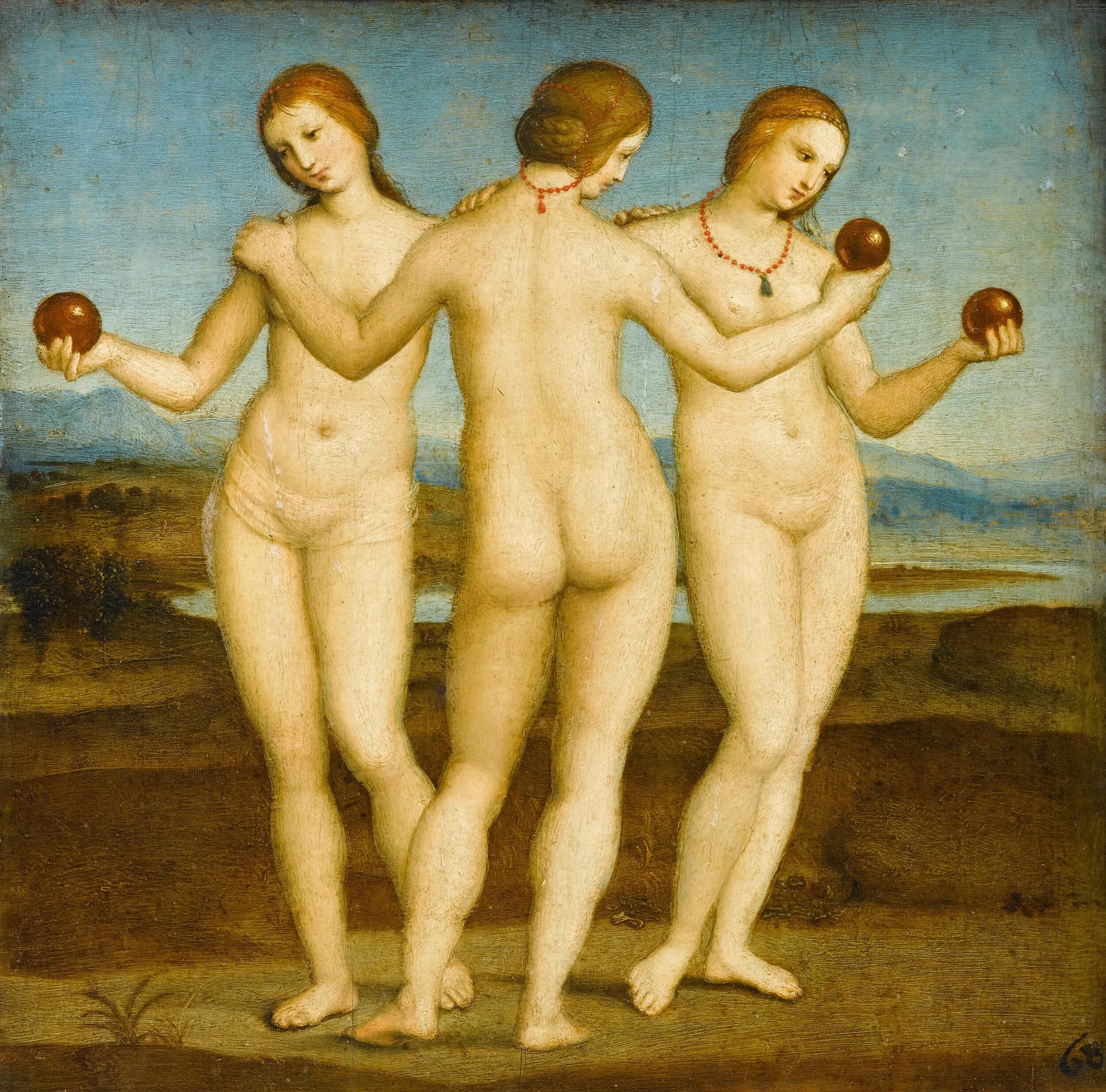
- Title: Three Graces
- Artist: Raphael (1483-1520)
- Date: c.1504
- Made in: Florence, Italy
- Medium: Oil on wood panel
- Dimensions: 17 × 17 cm
- Location: Musée Condé, Chantilly, France
- Photo credit: Google Arts & Culture on Wikipedia
When you walk up to Raphael’s "Three Graces" or "Three Hesperides" in Chantilly, the first surprise is how small the painting is, a seventeen-centimeter square.
Three nude young women stand close together in an empty landscape. They form a compact group: the woman in the middle turns her back to us, while the two on either side face toward her, so you see the female body from front, three-quarter, and back view all at once.
Each of the women holds a golden ball which can be construed to be a golden apple, which links them to classical myth of the Hesperides, the nymphs of evening and golden light of sunsets who conferred immortality to humans by giving them apples. The Hesperides were three, like the Three Graces and the Three Fates, other famous Greek triads.
Each of the women touches lightly with her other hand, one of her neighbor's shoulder, creating a soft chain that keeps your eye moving around the trio. Despite their idealized beauty, there’s something modest and almost shy about them: their heads tilt gently, their expressions are calm, and the poses have a quiet rhythm rather than showy drama.
The background is simple but important: a low horizon with soft hills and a pale, luminous sky that gives the figures room to breathe. Raphael uses very smooth transitions of light and shadow, so the bodies feel rounded and alive, but the contours stay clear and graceful. The whole little panel becomes a kind of “mini-manifesto” of harmony and balance from the young Raphael, showing how he could take a mythological subject and turn it into a perfectly poised meditation on beauty, movement, and the pleasure of looking.
Interestingly, the Musée de Condé's website indicates an X-ray of the painting revealed that its composition had been changed by the artist: originally, only one of the three women was holding a golden ball or apple, like in the Judgement of Paris and the three Greek goddesses: Hera, Athena and Aphrodite. Subsequently, Raphael changed his mind and put a round object in each woman’s hand, turning them into the three Hesperides. The three women look very much alike though with slight differences in hairdo, necklaces and drapery. This likeness makes them interchangeable, more like a triad then the three goddesses of the Judgement of Paris. The interchangeability of those three women may symbolize how, from a mortal's perspective, perfection or wholeness cannot be One and how that perfect balance comes from Three. A theme one can find in many religions, including in the Holy Trinity.
--
- At Musée Condé in the Chateau de Chantilly: Raphaeel's Three Graces
- On Wikipedia: Raphaeel's Three Graces
- On Wikipedia: A collection of the Three Graces in art (en français)