Honoré Daumier - The Third-Class Carriage (1862)
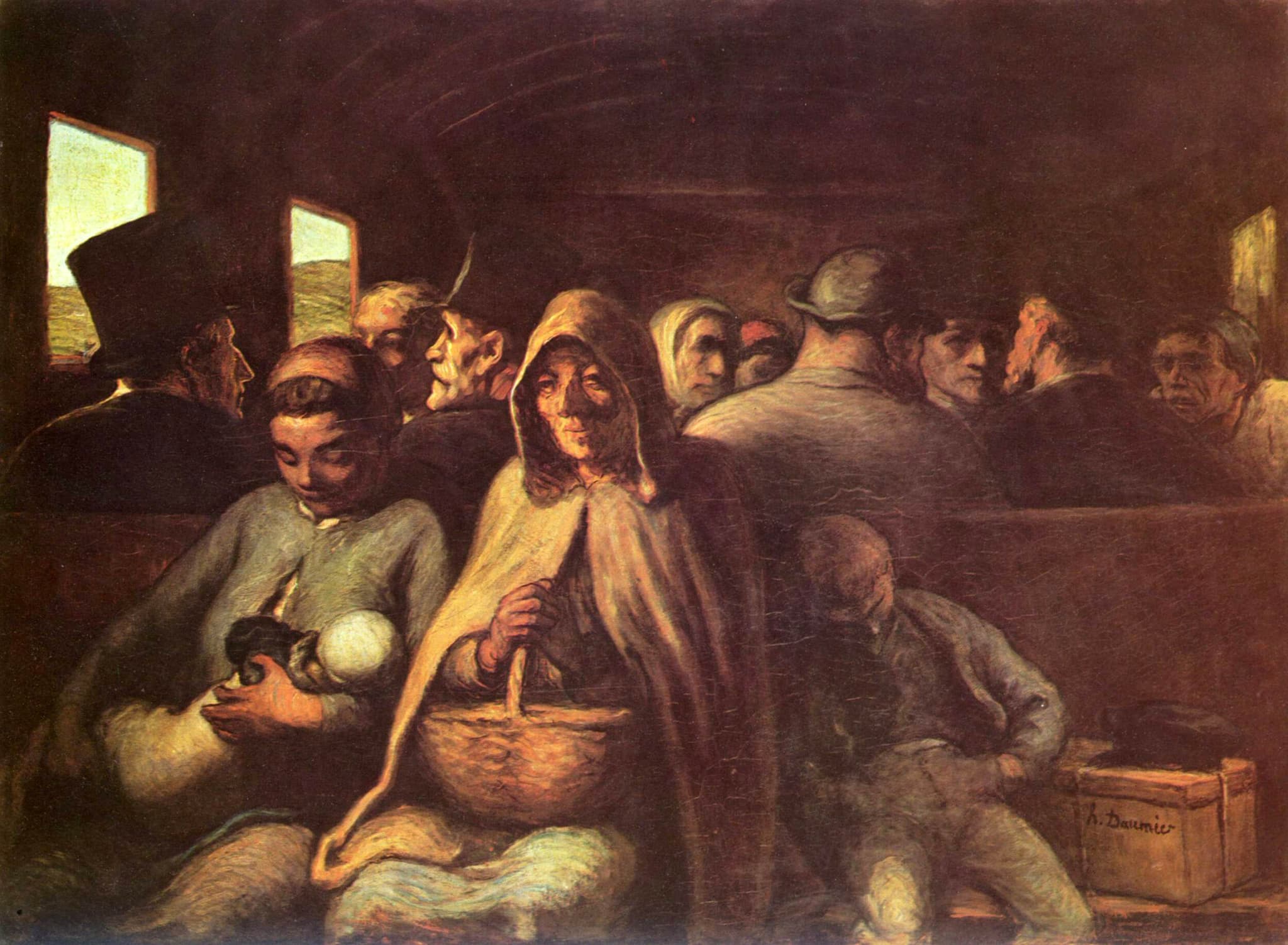
- Title: The Third-Class Carriage (Le wagon de troisième classe)
- Artist: Honoré Daumier (1808-1879)
- Date: 1862
- Made in: France
- Medium: Oil on canvas
- Dimensions: 65 x 90 cm
- Location: National Gallery of Canada, Ottawa, Canada
- Photo credit: Yorck Project by DIRECTMEDIA on Wikipedia
Honoré Daumier’s "The Third-Class Carriage" is one of the defining images of nineteenth-century social realism. Painted around 1862–64 in several closely related versions, most famously the unfinished canvas in the Metropolitan Museum of Art and a completed version in the National Gallery of Canada, it shows a compartment in a third-class railway carriage packed with working-class travelers.
Daumier places us directly in front of a hard wooden bench that runs across the foreground. On it sit three figures who anchor the whole composition: a young woman nursing or cradling a baby, an older woman in a hooded cloak holding a wicker basket, and a boy slumped forward in sleep. Behind them, rows of men and women fill the carriage, their hats and shoulders forming a dense backdrop. Through two small windows on the left we glimpse a strip of countryside, but the space is otherwise enclosed, cramped and airless.
The painting’s color is subdued and earthy: browns, dull ochres, smoky blues and greys. Daumier’s brushwork is broad and loaded, closer to Delacroix or Géricault than to the meticulous finish associated with academic painting. Forms are not crisply outlined so much as modeled in thick, energetic strokes, which gives the scene a slightly blurred, trembling quality, as if we were glimpsing it on a moving train. The result is a mixture of heaviness and flux: the bodies feel weighty and exhausted, yet everything is subtly in motion.
To understand the picture’s context you have to imagine railways were transforming France, binding city and countryside, speeding up commerce, and reorganizing daily life in the mid-nineteenth century. Daumier was less interested in gleaming locomotives than in the anonymous crowds they carried. Third-class carriages, the cheapest option, were bare compartments with wooden benches and little comfort, used by servants, laborers, and rural poor who commuted to the city or traveled for seasonal work. At the same time, Realist painters such as Courbet and Millet were insisting that the everyday life of workers deserved the same artistic seriousness as kings and gods.
The meaning of "The Third-Class Carriage" emerges from the tension between hardship and quiet dignity. The third-class railway travelers have plain clothes and simple faces but Daumier paints them without mockery. The travelers show no sign of animosity or anger, more tiredness and resolve.
Another crucial theme is the modern sensation of the “lonely crowd” whereby many people are jammed into a confined public space, physically close yet emotionally distant. The passengers turn in different directions, talk in fragments, or sit silently with eyes lowered. Third-class travel, devised to move masses cheaply, becomes emblematic of a society where individuals are reduced to anonymous bodies in transit.
"The Third-Class Carriage" helped secure Daumier’s status—posthumously as more than a caricaturist. His paintings were little known in his lifetime but have become staple images representing Realism. Daumier's works show how modern life itself—commuting, crowding, public transport—could be a serious subject for painting. Later artists who explored urban crowds and mass transit, from Degas to the Impressionists and even twentieth-century painters of subway scenes, owe something to Daumier’s insistence that the everyday discomforts of ordinary people were worthy of the highest pictorial attention.
--
- At National Gallery of Canada: Honoré Daumier - The Third-Class Carriage
- On Wikipedia: Honoré Daumier - The Third-Class Carriage