Frida Kahlo - Self-Portrait With Thorn Necklace and Hummingbird (1940)
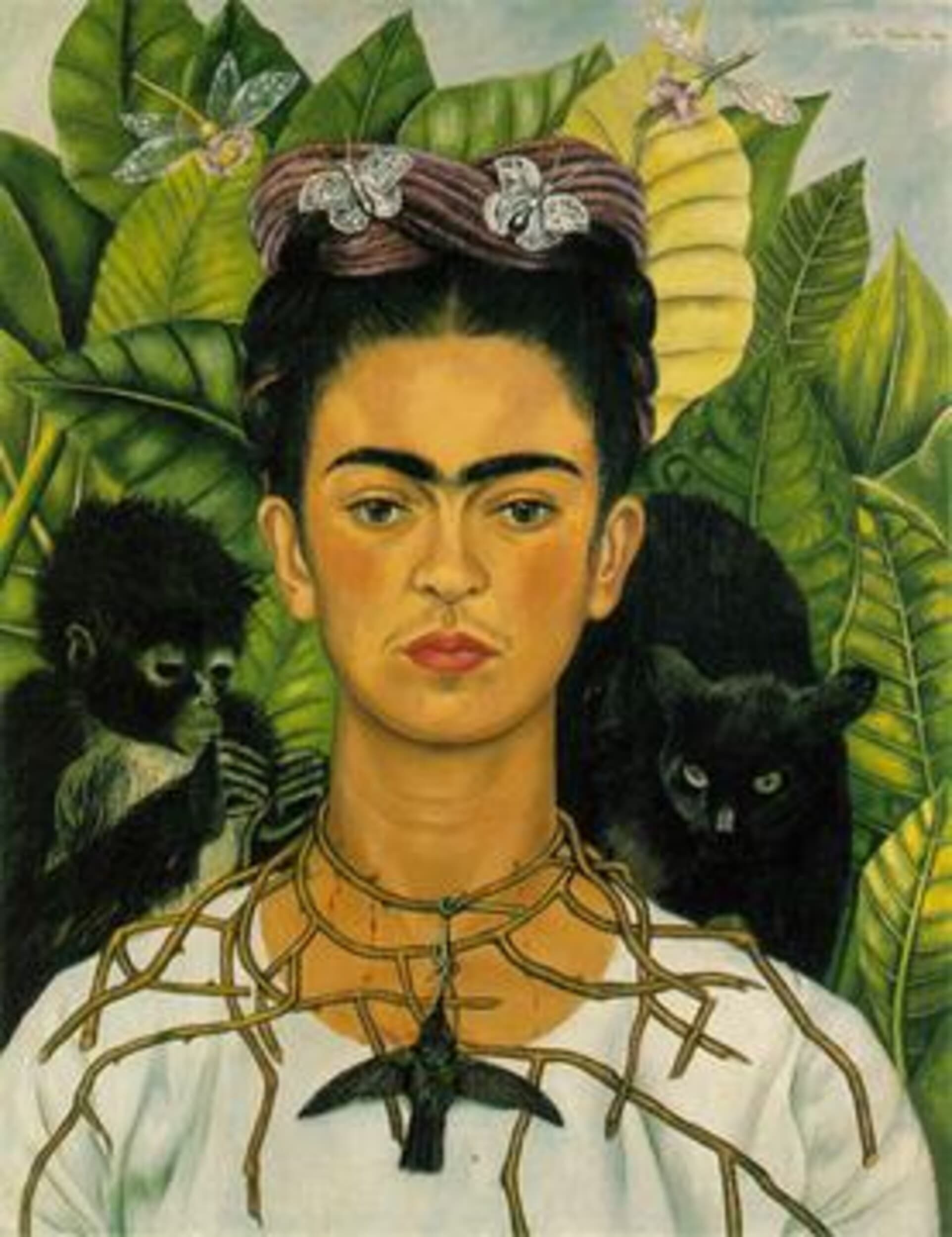
- Title: Self-Portrait With Thorn Necklace and Hummingbird (Autorretrato con collar de espinas y colibrí)
- Artist: Frida Kahlo (1907-1954)
- Date: 1940
- Made in: La Casa Azul, Mexico City, Mexico
- Medium: Oil on canvas
- Dimensions: 61 × 47 cm
- Location: Harry Ransom Center, University of Texas, Austin, Texas, USA
Frida Kahlo (1907–1954) was a Mexican painter whose life and work were shaped by illness, injury, and passionate politics. As a child she had polio, and at 18 she survived a devastating bus accident that left her in chronic pain. While bedridden, she began painting using a special easel and a mirror, leading to the many self-portraits that later defined her career.
She married muralist Diego Rivera in 1929; their intense, often turbulent relationship deeply influenced her art, as did her commitment to Mexican identity and communism.
Kahlo’s paintings mix realism and fantasy, often called Surrealist or magical realist, though she insisted she painted her own reality, not dreams. Her small, detailed works draw on Mexican folk art, Catholic and pre-Columbian symbols, and vivid depictions of the body. Through about 150–200 works, more than a third self-portraits, she explored pain, gender, motherhood, colonialism, and identity.
This specific self portrait is typical of how Frida Kahlo often painted herself: head-and-shoulders view, straight-faced, without a smile nor showing any emotion, insisting on her thick eybrows, and with no embellishmnent. She included many symbols in her painting: butterflies over her head showing how her mind is free and wanders in opposition to the necklace of thorns which draws her down and shows the lingering pain she endures from her past accident. The hummingbird makes us think of a cross dangling on the thorn necklace ; possibly, a rapport is to be drawn with Jesus wearing a thorn crown and being crucified. Other symbols such as the monkey and the luxuriant vegetation make us think of Mexican popular art and French painter Douanier Rousseau.
The Ransom Center website explains it "acquired the self-portrait in 1965 as one of a large collection of artworks assembled by photographer Nickolas Muray (American, b. Hungary, 1892–1965). Kahlo gifted the painting to Muray soon after it was completed in 1940. The collection, known as the Nickolas Muray Collection of Mexican Art, includes two other works by Kahlo—the 1951 Still Life with Parrot and Fruit and a 1930 drawing, Diego y Yo, inscribed by Kahlo to Muray."
Today Frida Kahlo is celebrated worldwide as a feminist icon and one of the most important Latin American artists of the 20th century.
--
- At Harry Ransom Center of the University of Texas (USA): Frida Kahlo - Self-portrait with thorn necklace and hummingbird
- On Wikipedia: Frida Kahlo - Self-portrait with thorn necklace and hummingbird
- On Google Arts & Culture: Frida Kahlo - Self-portrait with thorn necklace and hummingbird