Paul Klee - Dancing Girl (1940)
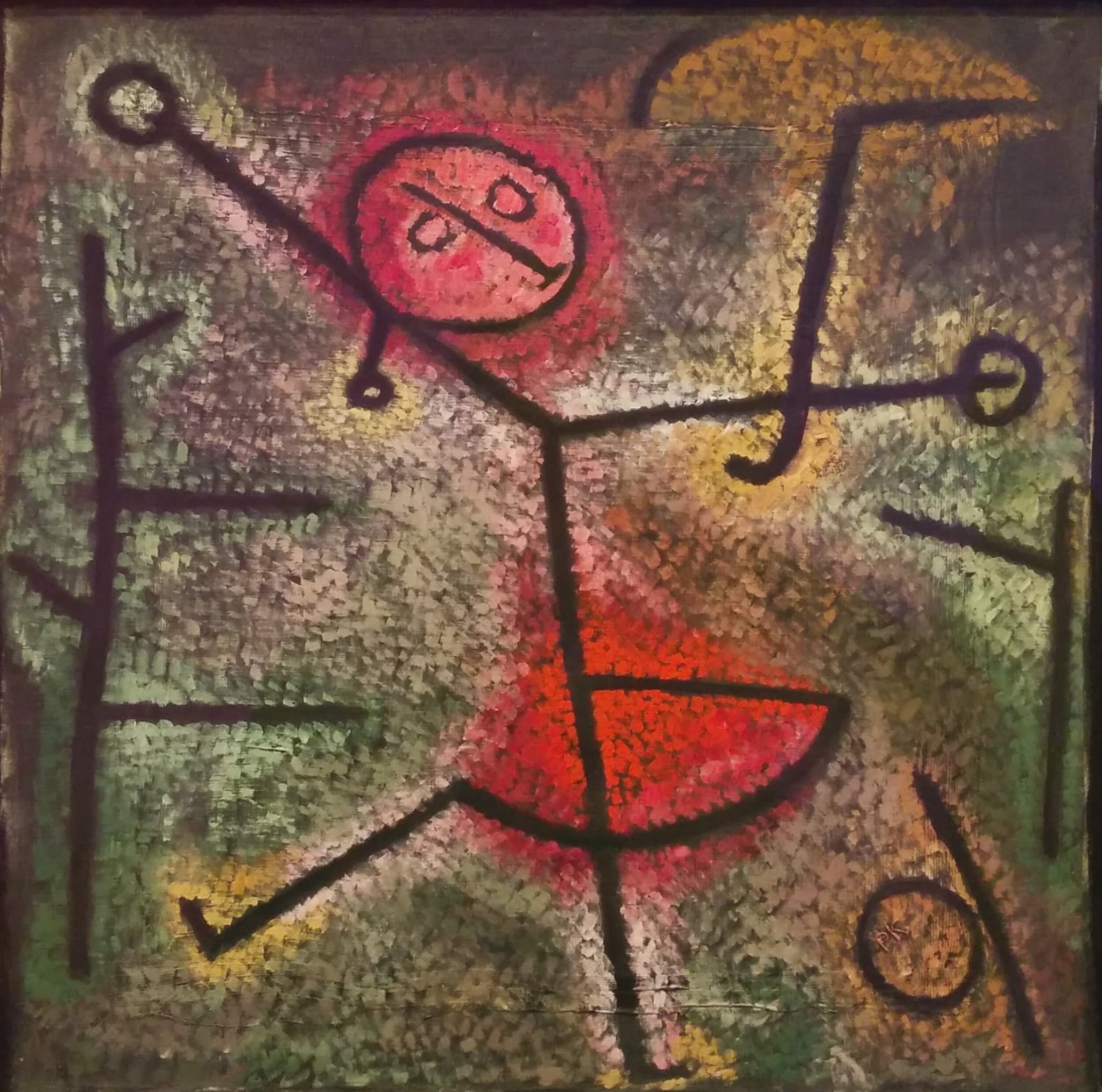
- Title: Dancing Girl
- Artist: Paul Klee (1879-1940)
- Date: 1940
- Made in: Switzerland
- Medium: Oil on cloth
- Dimensions: 53 × 51 cm
- Location: Chicago Institute of Art, Chicago, USA
- Photo credit: Roland Tricot at Art Institute of Chicago in January 2015
“Dancing Girl” is a late work by Paul Klee, painted in 1940 in oil on cloth and roughly square in format, a little over 50 centimeters per side. At the center of the composition, a stick-like figure with a circular head and skirted body seems to leap diagonally across the surface. The limbs radiate outwards in angled lines, giving a clear sense of movement, as if the girl is caught mid-step or mid-spin. Around her are a few spare, linear motifs—tree-like forms on the left, a curved shape at the top that reads as an umbrella or arch, and a smaller circle at the lower right—that suggest a kind of whimsical stage or landscape without ever becoming fully descriptive.
The background is built up from dense, stippled touches of paint, a kind of pointillist texture that shifts between greens, browns, yellows, and reds. Against this mottled field, the dancer’s body is picked out by strong black contours and a glowing zone of reddish-pink at the center, so she appears to vibrate or shimmer out of the ground behind her. Klee’s use of color here is both restrained and intense: the palette is relatively limited, but the contrast between dark surround and luminous central figure makes the dance feel almost like a flare of energy. This mix of flat linear drawing and richly worked surface is characteristic of his late style.
The figure herself is deliberately simple and slightly uncanny. Her head is a plain circle divided by a cross, with two small ovals for eyes; the “face” reads less as a portrait than as a sign or mask. One leg juts forward in a sharp angle, and the tilted “skirt” echoes that diagonal, reinforcing the idea of motion. The surrounding marks hover between objects and abstract signs, so the scene can be read as both playful and a little disorienting—like a child’s drawing that has been filtered through a very sophisticated visual language. Klee’s dry humor is present here too: in the original painting he even impressed his signature at the lower right using a monogrammed handkerchief, a small joke that underlines the work’s light, theatrical tone.
At the same time, “Dancing Girl” belongs to the final phase of Klee’s life, when he was living in Switzerland, branded a “degenerate” artist in Nazi Germany, and struggling with the debilitating illness. Many of his late works simplify forms into signs, hieroglyphs, and stick figures, yet they remain extraordinarily inventive in color and rhythm. In this context, the little dancer can be seen as a stubborn affirmation of movement and joy in the face of pain and constriction—a light, dancing figure who continues to whirl inside a dense, enclosing world.
--
- At Chicago Institute of Art: Paul Klee's "Dancing girl"
- On Wikipedia: Paul Klee's biography