Master of Charles de Duras - The Triumph of Venus Worshipped by Six Legendary Lovers (c.1300s)
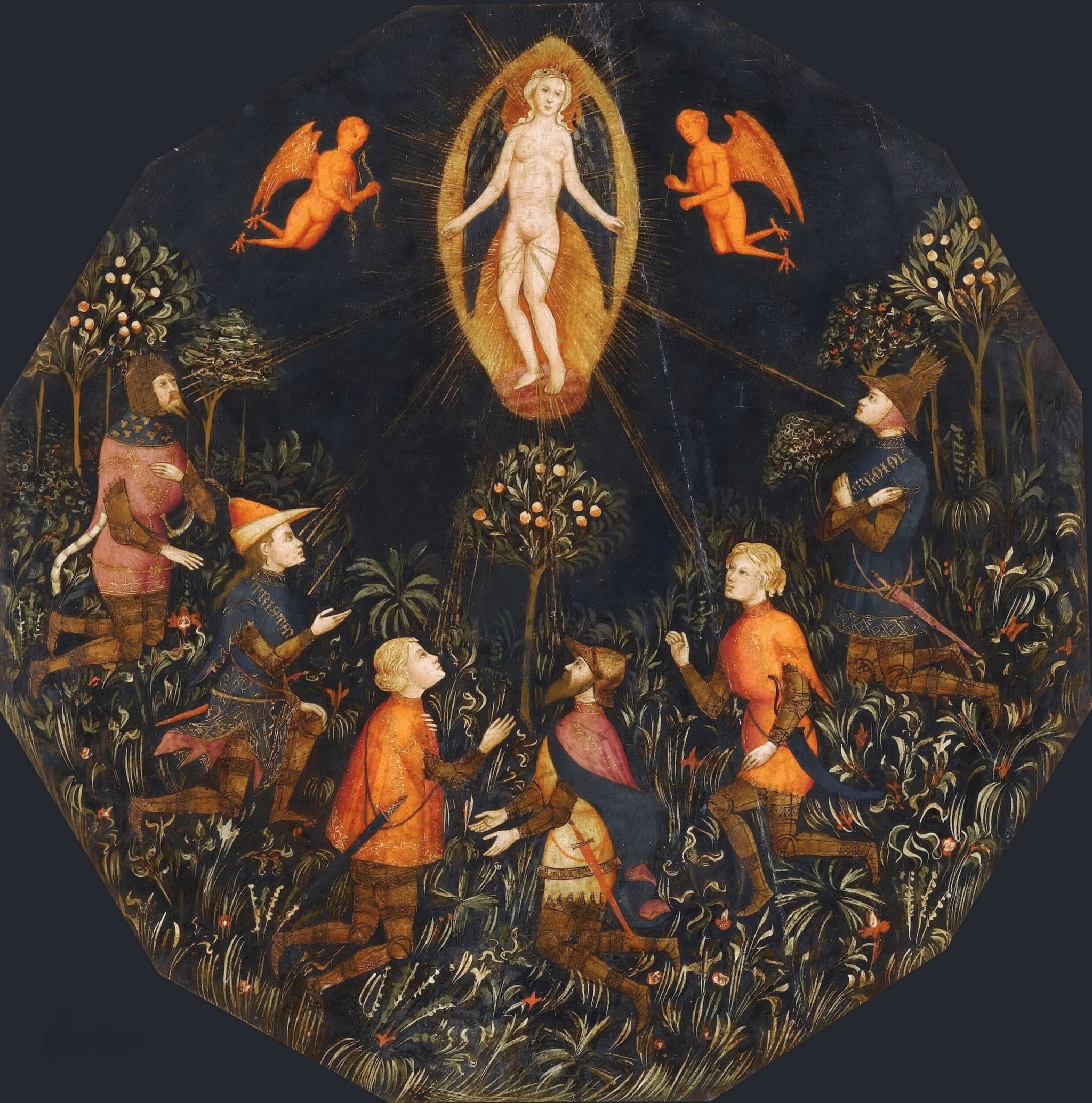
- Title: The Triumph of Venus Worshipped by Six Legendary Lovers (Achilles, Tristan, Lancelot, Samson, Paris and Troilus)
- Artist: Master of Charles de Duras (?-?)
- Date: c.1300s
- Medium: Tempera on poplar panel
- Dimensions: dodecagon of 51 cm diameter
- Location: Le Louvre, Paris, France
- Photo credit: GrandPalaisRmn (musée du Louvre) / Tony Querrec
The Master of Charles de Duras painted "The Triumph of Venus Worshipped by Six Legendary Lovers (Achilles, Tristan, Lancelot, Samson, Paris and Troilus)" in Florence around 1400.
It’s not a wall picture but a "desco da parto", a birth tray, that is a tray used in elite households to serve delicacies to the mother as she is expecting and about to give birth. The tray serves the double purpose of good omen and raising the spirits of the expecting mother. The tray can then be displayed in the home to give thank and praise for the good health of the mother and newborn infant. The painting is dodecagonal, tempera on poplar about 51 cm across, because of its original function-specific format as a tray.
Venus stands frontally within a golden mandorla, flanked by naked, winged cherubs. She is radiating beams, particularly beams that extend from her toward six male figures who approach her with devotion.
The six men embody a famous tale of desire that overwhelms prowess or prudence. The image compresses courtly, classical and biblical strands into a single spectacle of Love’s sovereignty, represented by Venus, goddess of Love. Their name is painted in gold color across the top of their garment making them so they can be identified, from left to right:
- Achilles, the nearly invincible Greek hero of the Trojan War, famed for his rage, bravery, and vulnerable heel;
- Tristan, the tragic medieval knight whose forbidden love for Isolde brings passion, betrayal, and sorrow;
- Lancelot, the Arthurian knight of unmatched valor whose love for Queen Guinevere helps destroy Camelot;
- Samson, the Biblical strongman whose divinely granted power is undone when Delilah betrays the secret of his hair;
- Paris, the Trojan prince whose abduction of Helen sparks the Trojan War and whose judgment in favor of Venus offends the gods;
- Troilus, the young Trojan prince whose idealistic love for Criseyde ends in heartbreak against the backdrop of war.
The iconography of birth trays often carry mythological “triumphs” that celebrate fertility, pleasure and lineage; here, Venus’s epiphany promises beauty and fecundity to the newborn’s household. At the same time, the cast of tragic lovers lets the picture operate as both celebration and caution, a nuanced reminder of Love’s power over heroes.
--
- At Le Louvre: Master of Charles de Duras - The Triumph of Venus