Ernst Ludwig Kirchner - Two Acrobats (1932)
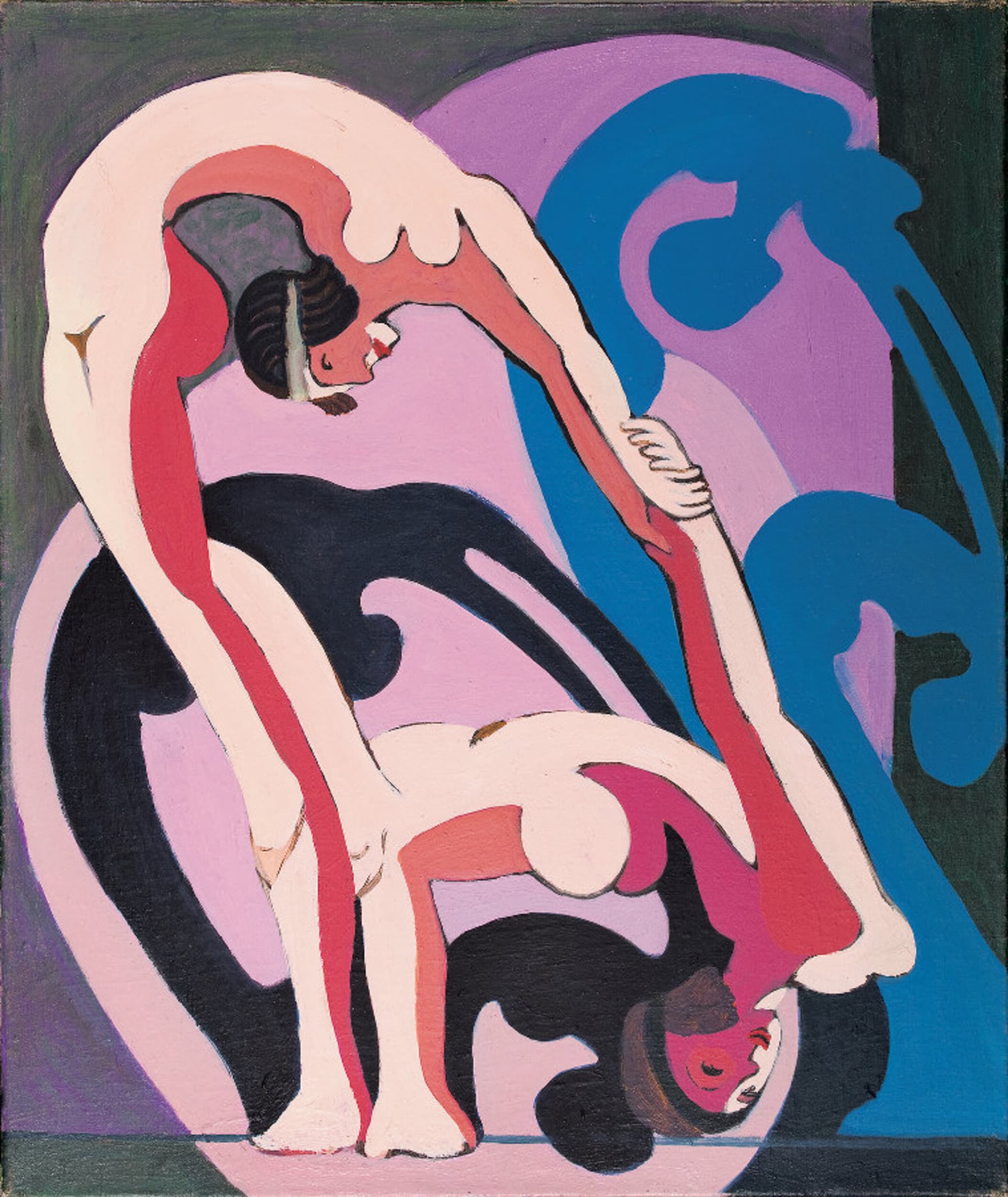
- Title: Two Acrobats
- Artist: Ernst Ludwig Kirchner (1880-1938)
- Date: 1932
- Made in: Berlin, Germany
- Medium: Oil on canvas
- Dimensions: 86 x 72 cm
- Location: Kirchner Museum, Davos, Switzerland
- Photo credit: Kirchner Museum Davos, Jakob Jägli
If you stand in front of Ernst Ludwig Kirchner’s "Two Acrobats", the first thing that hits you is how physical, elastic and flexible it feels. Painted around 1932–33, it shows two naked performers locked into an impossible balancing act: one arched in a deep bridge, the other hanging upside-down from that curve, so their bodies loop into a kind of living figure-eight. Their skin is an intense pink-orange, outlined in firm dark lines, and they’re set against a whirling backdrop of purple, blue, and black shapes that feel more like sound and movement than a realistic stage.
Look at how the composition works: Kirchner turns their bodies into a kind of acrobatic architecture. The limbs are elongated, a bit distorted, and the poses are exaggerated to the point where you feel the stretch in your own muscles. The space between them becomes almost as important as the bodies themselves, like cut-outs carved from the colored background. This is where his mix of Expressionism and a hint of Cubism shows up: the forms are simplified and angular, but the color is cranked up emotionally rather than “realistically.” The swirling dark shapes behind them work like visual noise from the circus tent or theater—everything around them is in flux, but the two figures are locked into a single, intense moment.
Kirchner had been obsessed with performers—dancers, cabaret acts, circus people—ever since his early "Die Brücke" years, and you can feel why here. These acrobats aren’t just pretty bodies; they’re people whose job is to weaponize their own physical risk. The pose is graceful, but it’s also clearly dangerous: if one of them slips, they both fall. That tension between elegance and collapse is central to the painting. The harsh outlines around knees, backs, and hands give the impression of strain under the skin, so it becomes a picture about what it costs to keep your balance, to keep the show going, to keep being spectacular for an audience you never quite see. Those two acrobats can feel like stand-ins for anyone trying to hold their life together under pressure. For a young person today, it’s easy to read it as a metaphor for hustle culture: your body and mind bent into extreme shapes to stay “on top,” while the world around you swirls in loud colors.
Kirchner doesn’t give you an easy moral or story; he just freezes that split second of risk and beauty and asks you to decide: is this thrilling, terrifying, or both?