Egon Schiele - The Family (1918)
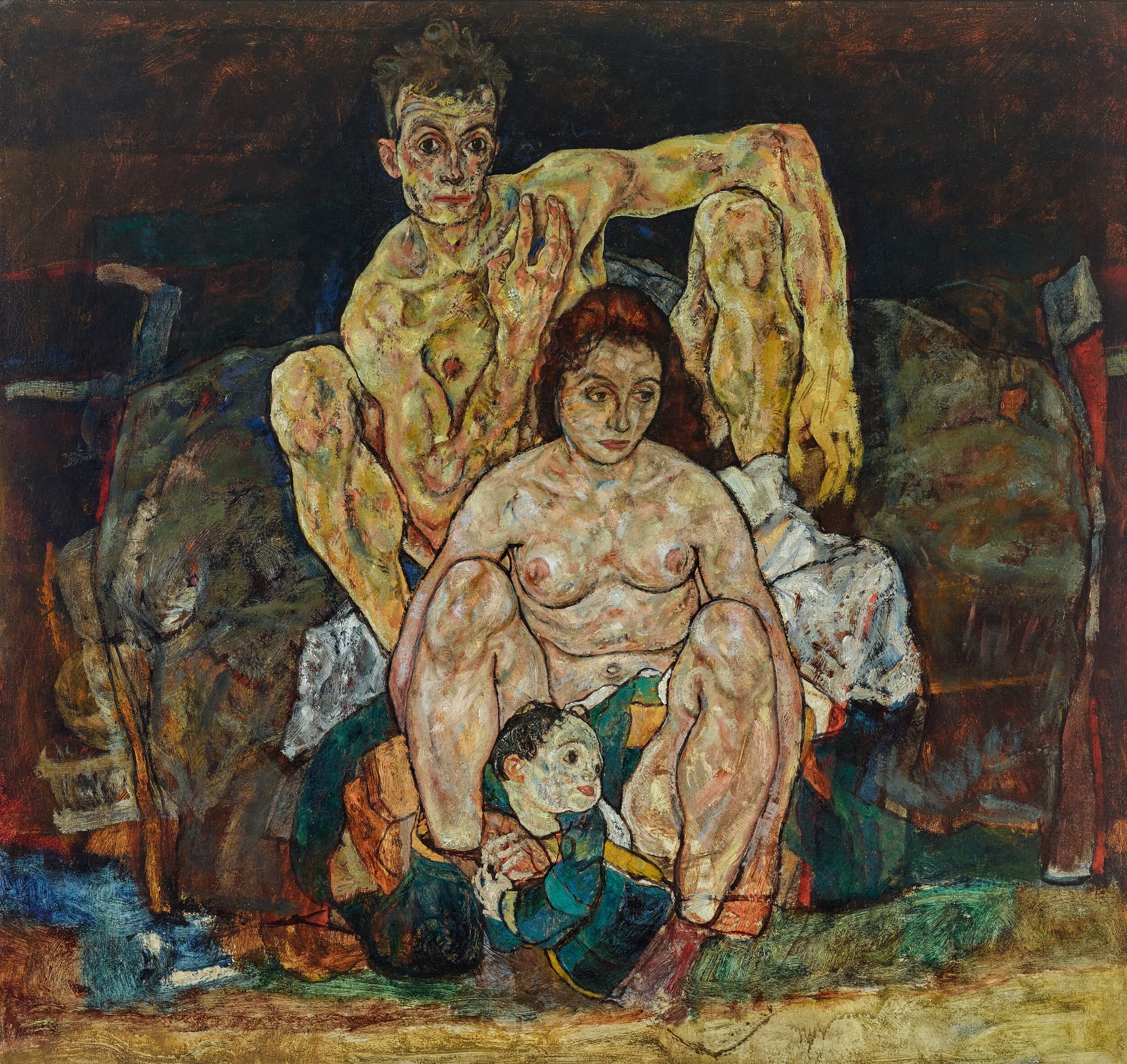
- Title: The Family (Die Familie)
- Artist: Egon Schiele (1890-1918)
- Date: 1918
- Made in: Vienna, Austria
- Medium: Oil on canvas
- Dimensions: 152 × 162 cm
- Location: Belvedere Gallery, Vienna, Austria
- Photo credit: Belvedere Gallery
Egon Schiele’s "The Family" shows three figures pressed tightly into the foreground: a man, a woman, and a small child. Commonly understood as Schiele, Edith (his wife) or Wally (his former lover) who would have been standing in for Edith, and a child. The child is symbolic: the work began as Crouching Couple and the baby was added later, likely reflecting the couple’s hoped-for family.
They sit on a bed or low platform, hemmed in by heavy drapery and dark, earthen tones that swallow the background. The father crouches behind the others, his angular body folded over his knees, eyes wide and alert. In front of him, the mother sits with her legs apart, body solid and volumetric, her gaze lowered and inward, as if absorbed in thought. Between her feet, the child looks out, the smallest figure but the brightest face, framed by the parents’ bodies like a fragile center.
Schiele’s line though still harsh, contouring every bone, tendon, and hollow, is less nervous and brutal than in his younger years. Skin is rendered in mottled patches of ocher, green, and rose, so that the bodies look at once alive and bruised, vulnerable and raw. The poses are intimate but tense: there is no easy embrace, no conventional gesture of affection, only a sense of dependency and fragile closeness. Their nudity feels less sensual than existential, as if they have been stripped down to the bare fact of being a family—three lives bound together in a confined, uncertain space.
The overall effect is both tender and unsettling. The parents’ expressions suggest worry, fatigue, and a kind of stoic acceptance, while the child introduces a faint note of hope.
Painted in the last year of Schiele’s life, on the eve of his wife’s and his own death in the influenza pandemic, the work reads like a meditation on continuity and mortality. "The Family" is not a sentimental image of domestic happiness, but a stark, emotionally charged vision of human beings clinging to one another in the face of an ominous, encroaching darkness.
--
- At the Belvedere Gallery: Egon Schiele - Die Familie (in German)
- On Wikipedia: Egon Schiele - The Family