Albrecht Bouts - Jesus in the House of Simon the Pharisee (c.1490)
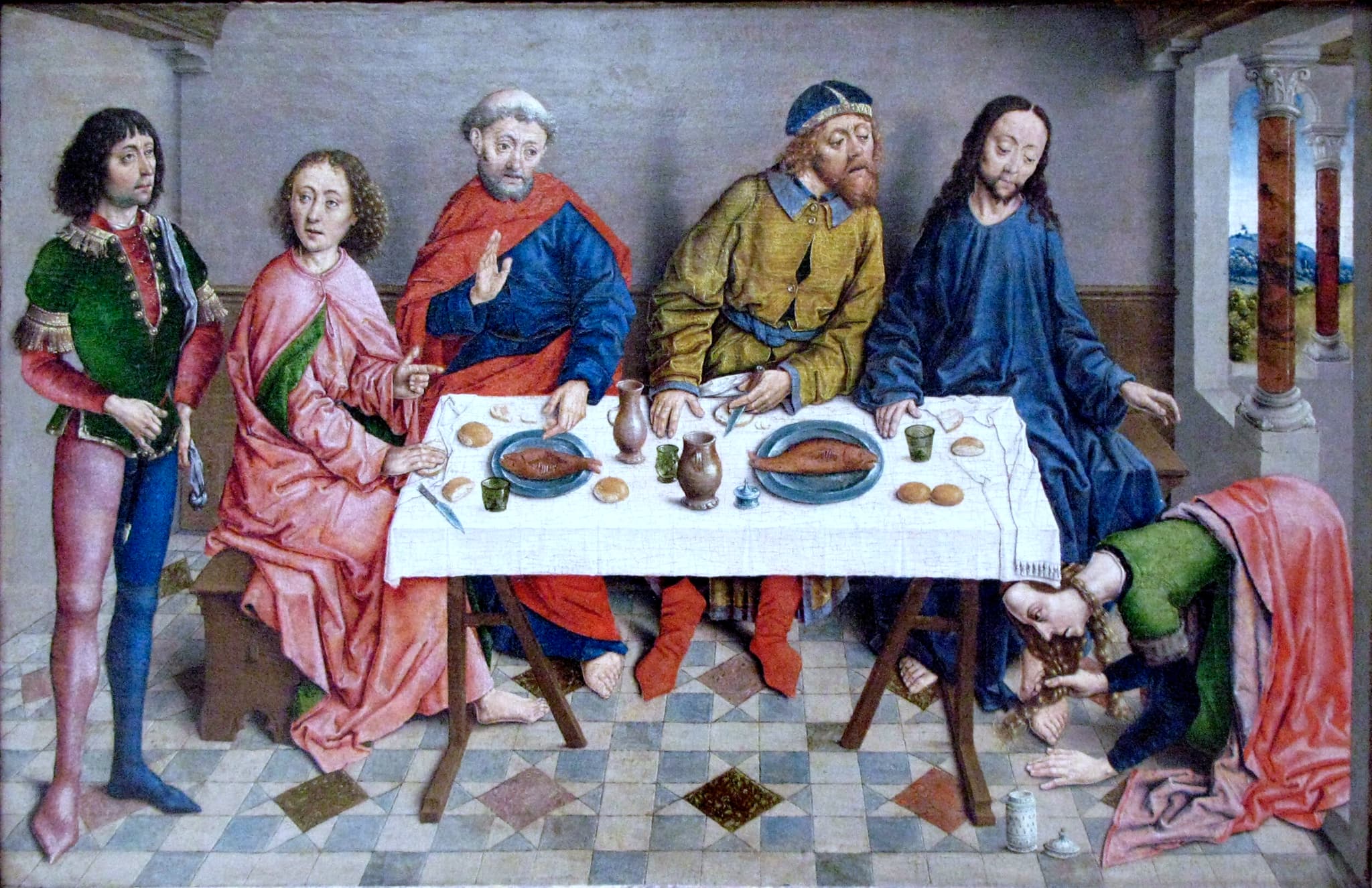
- Title: Jesus in the House of Simon the Pharisee
- Artist: Albrecht Bouts (c. 1452-1549)
- Date: 1540
- Made in: Leuven, Belgium
- Medium: Oil on oak panel
- Dimensions: 41 x 62 cm
- Location: Royal Museums of Fine Arts, Brussels, Belgium
- Photo credit: J. Geleyns at Royal Museums of Fine Arts of Belgium
Aelbrecht Bouts’s "Jesus in the House of Simon the Pharisee" shows Jesus seated at table in the house of Simon the Pharisee (a community within the Jewish people of Israel). The scene is compressed into a narrow interior with a tiled floor and a white-covered table running across the foreground. At the center-right, Jesus sits in a deep blue robe, his head slightly bowed and eyes lowered in a gentle, introspective expression. Around him, male diners in vividly colored garments—ochre, red, and blue—lean and gesture, their faces animated with conversation and curiosity. The intimacy of the space and the close grouping of figures make the viewer feel almost pressed up against the table, as if witnessing the meal at very close range.
Bouts illustrates the New Testament episode in which a woman anoints Jesus in Simon’s house, contrasting Simon’s lack of hospitality with the woman’s extravagant devotion. Jesus’s calm presence, slightly apart in mood if not in position, is the moral anchor of the composition. One man in yellow—likely Simon—sits next to him, leaning forward with knife in hand, caught mid-action between cutting bread and reacting to Jesus’s words or to the woman’s act. The painting is less about dramatic movement than about subtle psychological tension: the uneasy host, the self-contained Christ, and the implied figure of the penitent woman, whose presence we infer from the narrative rather than see fully staged at the center.
The work is rich in minute detail. The patterned floor tiles recede carefully in perspective, the linen tablecloth is dotted with loaves, jugs, bowls, and a fish rendered with jewel-like precision, and each vessel has its own glint of reflected light. The faces are individualized and pale, framed by fine curls or beards; their slightly elongated, inward-looking features echo the devotional panels of Bouts’s father, Dieric Bouts. The color range is clear and luminous—sharp blues, reds, greens—set against a quiet gray wall, so that the narrative objects and gestures stand out crisply.
Like many late-15th-century Flemish religious scenes, "Jesus in the House of Simon the Pharisee" collapses biblical time into the artist’s own world. The tableware, clothing, and tiled interior evoke a prosperous Northern household rather than first-century Palestine, inviting viewers to see their own dining rooms as potential sites of encounter with Christ. This work shares a similar topic but is very different in depiction and style than the one his father painted, Dieric Bouts’s "Last Supper".
--
- At Royal Museums of Fine Arts of Belgium: Albrecht Bouts - Jesus in the House of Simon the Pharisee