Pieter Neefs - Interior of the Antwerp Cathedral (c.1615)
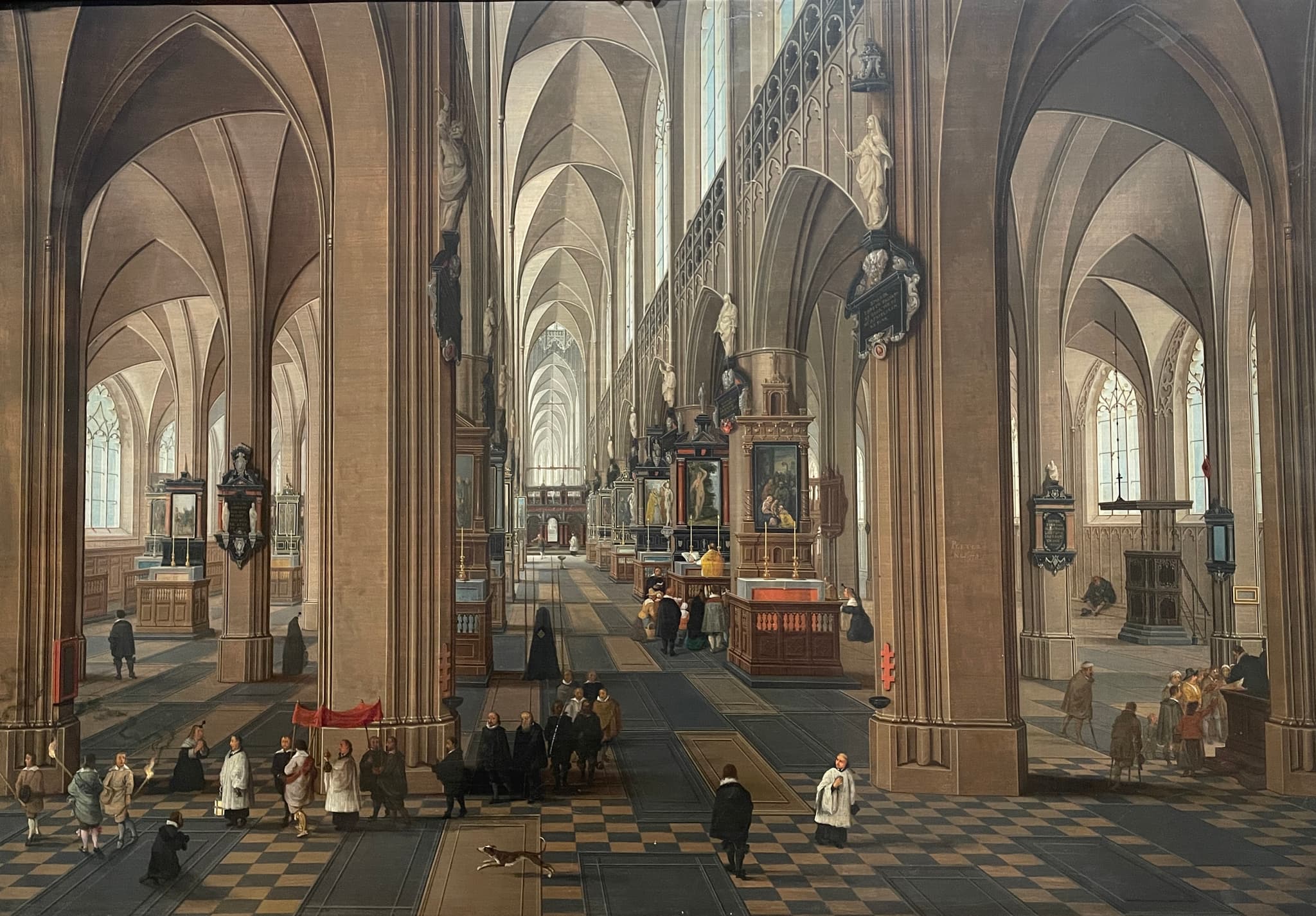
- Title: Interior of the Antwerp Cathedral (Interieur van de kathedraal te Antwerpen bij dag)
- Artist: Pieter Neefs (1578 - c.1660)
- Date: c.1615
- Made in: Antwerp, Belgium
- Medium: Oil on wood
- Dimensions: 59 x 84 cm
- Location: Old Masters Museum, Musées royaux des Beaux-Arts de Belgique, Brussels, Belgium
- Photo credit: Roland Tricot 2022 at Old Masters Museum
Pieter Neefs’s "Interior of Antwerp Cathedral" is like stepping into a Gothic architectural fantasy tour. The Cathedral of Our Lady (in Dutch: Onze-Lieve-Vrouwekathedraal) in Antwerp, Belgium, was started in 1352 and mostly ended in 1521, though never fully completed.
Neefs specialized in these long, sweeping views down the nave, and here he gives a representation of this Gothic space: soaring pointed arches, clustered columns, and a forest of ribs that pull your eye all the way to a tiny, bright focal point at the far end. The perspective is razor-sharp; every receding bay and vault is carefully plotted, like an architect’s drawing that has come to life with people and light.
What’s fascinating, especially if you like architecture, is how he shows the structure doing the storytelling. The huge piers are not just background; they’re vertical markers that give rhythm to the space, almost like a musical beat: pier, arch, vault, repeat. The ribs of the vaults fan out elegantly from each column, revealing how the load is distributed and how the weight flows down to the ground. Even the tracery in the high windows is treated with precision, as if Neefs is inviting you to read the building the way you’d read a set of plans, from foundation to clerestory.
While Neefs focused on the church interiors and was so successful with his architectural paintings, he would get leading Antwerp painters to paint the staffage (people and animals) in his works. In this painting, Frans III Franken (1607-1667) added the relatively tiny figures who stroll, talk, and pray across the checkered stone floor, their heads barely reaching the bases of the columns. These people are almost like measurement tools: they remind you just how massive the vaults are and how generous the spans between piers must be.
The tiled floor, drawn in perfect perspective, works like a built-in grid, leading you forward and emphasizing the depth of the nave - a trick in spatial design.
Neefs is not just documenting a church; he’s idealizing it, slightly polishing reality to express the “idea” of Gothic architecture: clarity of structure, incredible might and height, harmony of proportions, and light used almost like a building material. If you’re into architecture, this painting lets you experience the cathedral as both a real building and a conceptual model—a vision of what a perfectly organized sacred space could be, imagined through the eyes of someone who clearly adored its geometry.
--
- At Oldmasters Museum in Brussels: Pieter Neefs - Interior of the Antwerp Cathedral
- On Wikipedia: Biography of Pieter Neefs